What Size Room Do You Need for a Golf Simulator?
Find the ideal golf simulator room size for your home or business, including ceiling height, room depth, width, screen clearance, and layout tips.
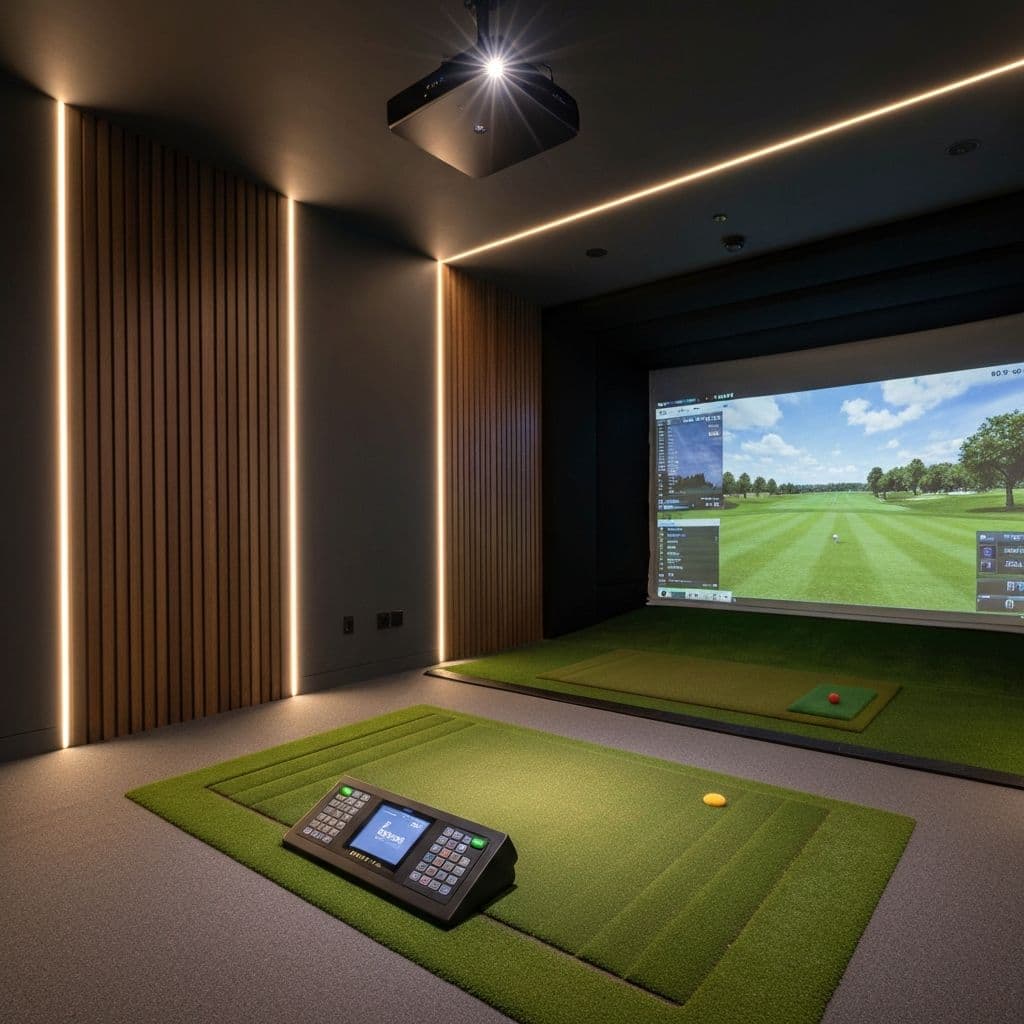
The short answer is this: for most golfers, a very comfortable golf simulator room starts around 10 feet of ceiling height, 15 feet of width, and 18 feet of depth, though some systems can work in smaller spaces depending on the launch monitor and layout. Trackman currently uses that 10' high, 15' wide, 18' deep benchmark in both its simulator guidance and technical specs, while other golf simulator sellers publish similar "ideal room" ranges. The best thing to do is go grab your driver and take some swings in that room.
What is the minimum room size that can work?
This is where a lot of people get tripped up.
A smaller room can work, but the answer depends on:
- your height
- your swing shape
- whether you want to hit driver
- whether right- and left-handed golfers will both use it
- which launch monitor you choose
- how much compromise you are willing to accept
A home setup around roughly 15 feet of depth, 10 feet of width, and 9 feet of height is definitely doable — it just might feel a little small at first.
Ceiling height matters more than people think
Ceiling height is usually the first thing to check.
If the ceiling is too low, the rest of the room doesn't matter much. Current guidance across major simulator brands and sellers generally lands in the same place: 9 feet may work for some golfers, but 10 feet is the safer target for full swings, especially with driver.
Width is about more than just the screen
People often focus on screen size first, but width is really about swing clearance.
A room that is too narrow can create issues on the backswing and follow-through, especially if the hitting area is centered or if both right- and left-handed players need to use the same setup.
In practical terms, narrower rooms may still work, but they usually require more careful bay placement and often feel more limiting with longer clubs.
Depth affects safety, screen fit, and projector planning
Depth is what gives the room breathing room.
Golfers generally stand about 8 to 10 feet from the screen.
We also recommend leaving 12 to 16 inches of space behind the screen and keeping a small dimensional buffer around the screen itself — roughly 4 inches above and 4 to 6 inches across the width so the screen isn't packed tightly into the room. We can go wall to wall with a built-in to maximize width and put padding behind the screen to maximize depth.
That's why room depth isn't just about whether you can stand and swing. It also has to accommodate:
- the buffer behind the screen
- the ball-to-screen distance
- space behind the golfer
- projector location
- safer bounce-back behavior
Can a 12 x 12 room work?
A 12' x 12' room may work for short irons, but most players will feel constrained — especially with driver — and some simulator technologies simply won't be a good fit in that space. We do not recommend a room this size.
So if someone asks whether a 12 x 12 room is "enough," the better answer is: it may be enough for a compromised setup, but it is usually not the benchmark for a full, comfortable simulator room.
Does launch monitor type change the room requirement?
Yes — sometimes a lot.
That's one reason you should not buy equipment first and try to force it into the room later. The room and the technology need to match each other.
The best way to measure your room
Before buying anything, measure these six things:
- Floor-to-ceiling height at multiple spots
- Clear width wall to wall
- Total depth of the room
- Distance you can realistically stand from the screen
- Space behind the screen
- Obstructions like lights, soffits, vents, ceiling fans, doors, beams, and trim
And before you do anything else — take a club into the room and make a few slow practice swings.
So what room size should you aim for?
If you want the simplest answer:
- Best-case target: 10' high × 15' wide × 18' deep
- Workable for many homes: around 9–10' high, 10–12' wide, 15' deep, depending on golfer and equipment
- Likely too tight for most full setups: 12' × 12' rooms or 8' ceilings
That gives you a much better planning framework than the generic idea that "any spare room can become a simulator room."
Not Sure if Your Room Will Work?
At Pop's, we design and install custom golf simulator spaces for homes and businesses across Texas.
If you're trying to figure out whether your garage, bonus room, media room, or commercial space can support a golf simulator, we can help you plan it before you buy the wrong equipment.
Start a conversation with our design assistant and we'll help you understand what your room can support, what compromises may be required, and what kind of setup makes the most sense.
Ready to build your dream simulator?
Get in touch with our team to start designing your custom golf room.
Get Started